"What if everyone leaves the moment I hand over the keys?"
If you’re thinking about selling your property management business, that thought has likely kept you up at 2:00 AM.
You’ve spent years, maybe decades, building relationships with your landlords. You know their kids' names, their favorite coffee, and exactly how they like their monthly statements formatted.
You know the value of those relationships. But a buyer? A buyer only sees a contract. And they are terrified that those contracts will vanish the second you walk out the door.
This is why the retention period exists.
It isn’t a trap. It isn’t a way for a buyer to "nickel and dime" you at the finish line.
It is a standard industry mechanism designed to bridge the gap between your ownership and the buyer’s future.
Not a penalty, but a bridge
Maybe you’re feeling the weight of the daily grind. Maybe you’re ready for a new chapter.
When you decide to sell, you aren't just selling desks, computers, and a brand name. You are selling a stream of recurring revenue.
In the property management world, that revenue is tied to "doors." And those doors are attached to people: landlords who may or may not like the idea of a new management company taking over.
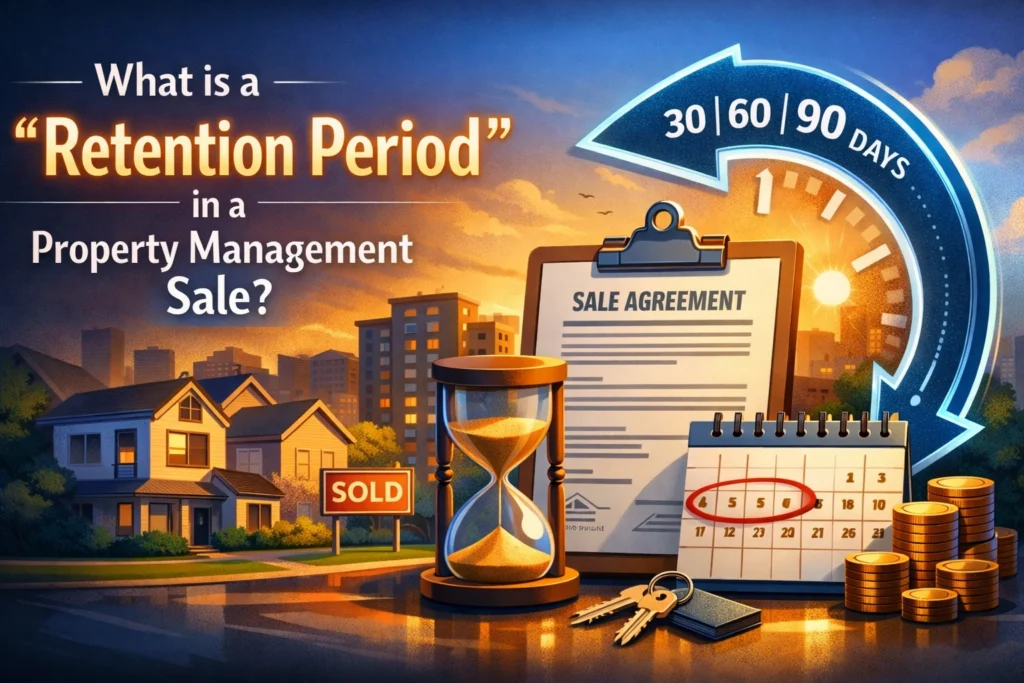
A retention period is a specified timeframe after the sale: usually 90 to 180 days: where a portion of the purchase price is held back.
This money sits in a safe spot, usually a solicitor’s trust account or an escrow account.
It acts as a security blanket for the buyer. If the "rent roll" (your list of managed properties) stays intact during this transition, you get every penny of that held-back money.
If landlords leave because they don’t like the change, the purchase price is adjusted downward to reflect the actual value of what was delivered.

Why do buyers insist on a retention period?
It’s helpful to step into the buyer’s shoes for a moment.
Not to sympathize with them, but to understand the logic of the deal.
When a buyer looks at how much a property management business is worth, they are calculating a multiple based on your Management Fee Income (MFI).
They are paying you for a future they haven't seen yet.
Statistics show that, on average, about 5% of landlords will leave during a transition. They might use the sale as an excuse to sell their property, or they might simply be uncomfortable with a new team.
The buyer wants to make sure they aren't paying $3,000 per door for a door that slams shut three weeks after the closing date.
The retention period ensures the buyer isn’t overpaying for a ghost portfolio.
The mechanics: How much and how long?
In most property management sales, you aren't getting 100% of the cash at the closing table.
It’s more common to see a "80/20" or "90/10" split.
- The Initial Payment: 80% to 90% of the total price is paid to you on day one.
- The Retention Amount: 10% to 20% is "held back."
- The Timeline: This holdback typically lasts between 3 and 6 months.
If you are selling a smaller portfolio, the period might be shorter. If it’s a massive enterprise with complex institutional owners, it might lean toward the six-month mark.
It is a test of stability.
Not what you promise the stability will be…
But what the stability actually is once you are no longer the one answering the phone.

The "Clawback": When the price goes down
This is the part that makes sellers nervous.
If a landlord terminates their management agreement during the retention period, the buyer is entitled to a "clawback" or a "settlement adjustment."
How does it work?
Let’s say you sold your business for a multiple of 3x your annual management fees.
If a property that generates $2,000 a year in management fees leaves during the retention period, the buyer is technically "losing" $6,000 of value ($2,000 x 3).
That $6,000 is deducted from the retention funds before they are released to you.
However, there are rules to this game.
A fair contract will specify that you only lose money if the loss of the client was "out of the buyer's control."
If the buyer is incompetent, ignores the landlords, or doubles the fees overnight, causing them to leave, you shouldn't be the one paying for it.
This is why how to sell a property management business without losing value often comes down to the quality of the buyer you choose.
Protecting your payout: The seller’s strategy
You shouldn't just cross your fingers and hope for the best during the retention period.
There are strategic steps you can take to ensure you receive 100% of your holdback funds.
- The Hand-Off: Don’t just vanish. A "warm" introduction to the new owner is vital. Landlords need to feel that they are being handed over to someone you trust.
- Documentation: Ensure your files are clean. If a buyer can’t find a management agreement or a property condition report, they may use that "messiness" as leverage during the retention count.
- Vet the Buyer: Work with a professional like PM Business Broker to find a buyer who actually knows how to manage properties. If the buyer is a pro, they will keep your owners happy, which keeps your money safe.
- Review the "Exclusions": Make sure your contract excludes "lost doors" that have nothing to do with the sale. If an owner sells their house or passes away, that isn't a reflection of the transition: it's just life. You shouldn't be penalized for it.

Facts over assumptions
It is easy to get emotional during this process.
You might feel like a retention period is an insult to the loyalty of your clients.
"My owners would never leave me," is a common sentiment.
But business sales are built on facts, not assumptions.
A retention period is simply a way to turn an assumption of loyalty into a factual record of performance.
It aligns your interests with the buyer's interests. You both want the owners to stay. You both want the transition to be seamless.
When interests are aligned, the deal is much more likely to close successfully.
Clarity over guessing
Maybe you aren't ready to sell today.
Maybe you’re just curious about how the process works so you can plan for two or three years down the road.
Understanding the retention period now allows you to prepare.
It encourages you to look at your rent roll objectively.
Which owners are "at risk"? Which ones only stay because they are your personal friends?
By identifying these "flight risks" early, you can shore up those relationships or diversify your portfolio so that a single loss doesn't tank your retention payout.

Getting started with a plan
The retention period is just one piece of the puzzle.
From how buyers value a property management business to the final release of funds, the process is a marathon, not a sprint.
It requires a steady hand and a calm perspective.
You don't need to have all the answers right now. You just need to know what questions to ask.
If you’re feeling the weight of the clock, or if you’re just looking for clarity on what your options are, start by looking at the numbers.
Not what you wish the business was worth…
But what the market: and a retention-protected buyer: will actually pay.
The goal isn't just to sell.
The goal is to sell, walk away with your head high, and keep the money you worked so hard to earn.
If you're looking for more guidance on the specifics of the transition, you might find it helpful to explore our services or reach out for a quiet, low-pressure conversation.
Options are always better than guesses. Clarity is always better than hope.