Maybe you’ve spent a decade building your portfolio.
Maybe you know your numbers by heart.
But as you look at your business, a quiet thought starts to surface: How is a stranger going to believe me when I tell them what this business earns?
It’s a natural concern. In the world of property management, income isn't just a number on a page. It is a complex web of management fees, leasing commissions, late fees, and maintenance markups.
When it comes time to sell, a buyer isn't going to take your word for it. They aren't even going to take your internal spreadsheet’s word for it.
Verification is the process of turning your claims into proven facts.
It is the bridge between a "handshake deal" and a successful closing.
The Shift in Perspective
Not what you feel the business is worth.
But what the documentation proves it can sustain.
If you are managing between 100 and 1,500 doors, your business has reached a level of complexity where "rough estimates" no longer work. Buyers at this scale are often sophisticated. They might be private equity groups, larger regional players, or experienced individual investors.
They aren't looking to catch you in a lie. They are looking for the confidence to move forward.
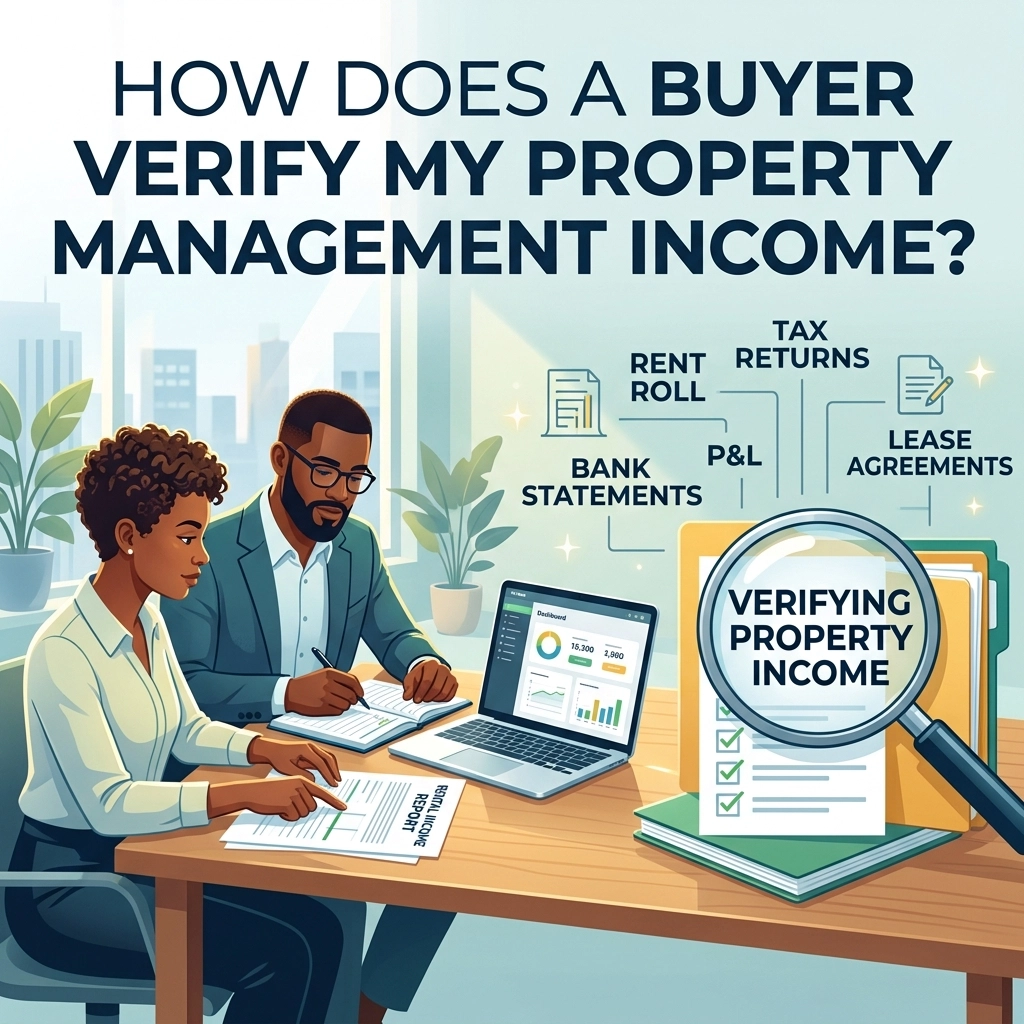
Here is exactly how a buyer verifies your property management income.

1. The Source of Truth: Property Management Software Reports
The first place a buyer looks is your property management software: AppFolio, Buildium, RentVine, or Yardi.
This is the digital footprint of every transaction in your business. A buyer will request specific reports, usually covering the last 24 to 36 months.
- Management Fee Reports: They want to see the actual fees collected, not just the "expected" fees based on your door count.
- Income by GL Code: This breaks down where the money is coming from. Is it 90% management fees, or are you heavily reliant on one-time tenant fees?
- Unit Reconciliations: They will match your active door count to the income being generated to ensure the "average revenue per unit" (ARPU) makes sense.
Buyers use these reports to verify the consistency of your revenue. They are looking for patterns. If income spikes every March and drops every September, they want to know why.
2. The Hard Evidence: Bank Statements
If the software is the "plan," the bank statements are the "reality."
A buyer will typically ask for 12 to 24 months of business bank statements. They aren't just looking at the balance; they are looking for deposits that match your software reports.
- Verification of Deposits: Do the monthly management fees transferred from the trust account to the operating account match the income reported in your software?
- Cash Flow Analysis: They want to see that the business is actually keeping the money it claims to earn.
- Transparency: Any discrepancy between your reported income and your actual bank deposits will be a red flag.
In many ways, the bank statement is the ultimate "BS detector" in what financial records buyers review during due diligence.
3. The Official Record: Tax Returns
Not what your internal P&L says before your CPA makes adjustments.
But what you told the IRS you earned.
Tax returns are considered the "Gold Standard" of verification. Most buyers will ask for the last three years of business tax returns (Form 1065, 1120-S, or Schedule C).
There is a simple reason for this: very few business owners overstate their income to the IRS. If you reported $500,000 in profit to the government and paid taxes on it, a buyer can be reasonably certain that you actually made that money.
However, many property management owners "run things through the business" to reduce their tax liability. This is where "Add-Backs" come in. You might have a personal vehicle, health insurance, or a family member on the payroll that wouldn't exist under new ownership.
A buyer will verify these expenses to arrive at the SDE (Seller’s Discretionary Earnings).

4. Triangulation: The Reconciliation Process
Verification is not about looking at one document. It is about "triangulating" three points of data.
- The Software: Says you earned the money.
- The Bank: Says you received the money.
- The Tax Return: Says you kept the money.
If all three of these numbers align, the verification process is smooth. If they don't, the buyer will dig deeper.
For example, if your software says you earned $1M in management fees, but your tax return only shows $800,000 in total revenue, there is a $200,000 gap that needs an explanation. Without a clear explanation, the buyer will value the business based on the lower number.
This is why understanding how buyers value a property management business is critical before you even list the company for sale.
5. The Contractual Foundation: Management Agreements
Income is only valuable if it is "sticky."
A buyer will verify your income by auditing a random sample of your management agreements. They want to see that the fees you are charging (and the income you are reporting) are actually backed by signed contracts.
- Fee Consistency: If you tell a buyer your management fee is 10%, but the contracts show 7%, the income isn't verifiable.
- Termination Clauses: They will look at how easily owners can leave. If 50% of your income is at risk because of "cancel at any time" clauses with no penalty, the value of that income decreases.
- Owner Concentration: If one owner represents 20% of your doors, the buyer will verify that specific relationship meticulously.

6. The "Per Door" Verification
For owners in the 100-1,500 door range, buyers often look at "Revenue Per Door."
They will take your total management income and divide it by your active door count. If the market average is $150 per door but you are claiming $250, they will want to see exactly which ancillary fees (maintenance markups, HVAC filter programs, etc.) are driving that number.
They will then verify those specific programs by looking at vendor invoices and tenant ledgers.
If you are curious about how your specific door count impacts your valuation, you can explore how much is a property management company worth per door.
Why Verification Feels Stressful (And Why It Shouldn't)
It is easy to feel defensive during this process.
It can feel like your integrity is being questioned.
But from the buyer's perspective, this is simply risk management. They are likely taking on debt or risking their life savings to buy your life's work. They need to be sure.
The best way to handle verification is with radical transparency.
- Organize early. Don't wait for a buyer to ask for bank statements to start downloading them.
- Be honest about "Owner Perks." If you use the company card for a personal vacation, tell the broker or the buyer upfront. It’s a common "add-back," but it looks like a "cover-up" if they find it first.
- Use Professional Guidance. Working with experts like Vision Fox Business Advisors can help you prepare your financial "book" so that it stands up to the scrutiny of a sophisticated buyer.
The Professional Reality
Not a mystery.
But a calculation.
If your books are clean, your software is updated, and your taxes are filed, you have nothing to fear from the verification process. In fact, clean verification often leads to a higher multiple because it reduces the buyer's perceived risk.
The more "verifiable" your income is, the more valuable your business becomes.
Maybe you aren't ready to show your books to a buyer today. Maybe you are just starting to think about what the future looks like.
That’s fine.
But the decisions you make today regarding your record-keeping will dictate the check you receive when you finally decide to walk away.
If you want to understand the timeline of this process, you can read more about how long it takes to sell a property management company.
Stay steady. Keep your records clean. Let the facts speak for themselves.