“Why does a buyer need so many documents before they even know whether they want to buy my company?”
Many property management owners have that quiet thought when a buyer requests access to a data room.
It can feel like an unnecessary amount of paperwork. But a data room is not meant to create confusion or expose your business too early.
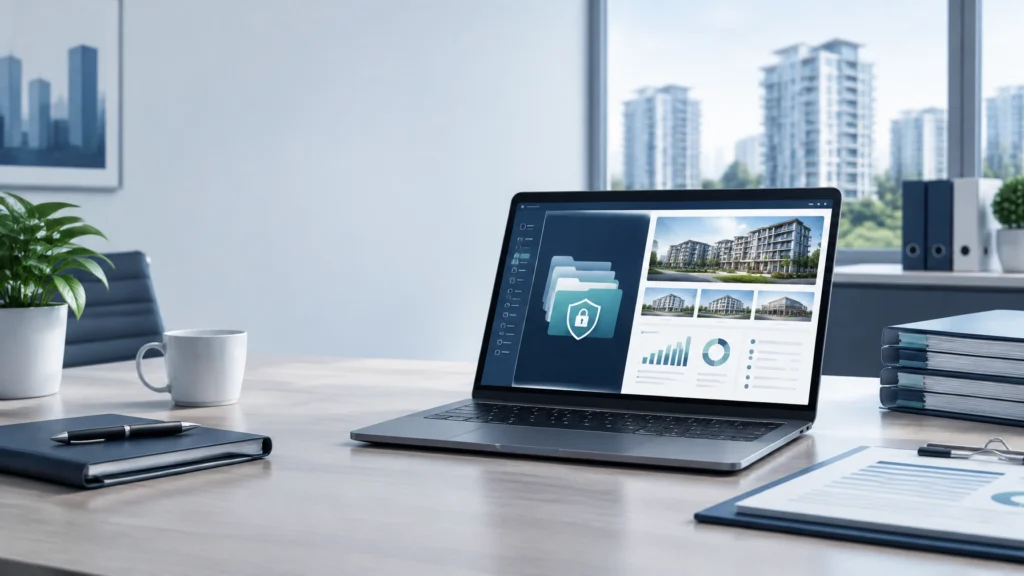
It is a secure, organized place where a buyer can review the information needed to evaluate your property management company and confirm that the business is what it appears to be.
Not a dumping ground for every file you have.
A data room is a controlled way to provide the right information, in the right order, to the right people.
What Is a Data Room?
A data room is a secure online collection of documents used during a business sale. It may be hosted through a virtual data room provider, a broker’s transaction platform, or another secure document-sharing system.
The room is typically divided into folders, such as:
- Financial information
- Management agreements
- Rent roll and portfolio information
- Bank and trust account records
- Employees and organization
- Technology and software
- Legal and compliance documents
- Other requested business records
The buyer and their advisors use the data room during due diligence. They review your records, compare them with the information presented earlier in the process, and identify questions that need to be answered before closing.
The goal is not simply to hand over documents.
The goal is to make the business easier to understand.
Why Do Buyers Ask for a Data Room?
A buyer is considering paying a significant amount of money for an operating company, its client relationships, its management agreements, and its future cash flow.
They need to verify the facts behind the opportunity.
A data room helps a buyer answer questions such as:
- How many doors are actually under management?
- Which clients generate the company’s revenue?
- How stable are the management agreements?
- Are the financial statements accurate?
- Does the business have consistent cash flow?
- Are there trust account issues or unreconciled balances?
- How dependent is the company on the owner?
- Can the buyer continue operating the business after the sale?
Not what the business feels like it is worth.
What the records support.
This process also protects you as the seller. When information is organized and easy to verify, the buyer has less reason to rely on assumptions. That can reduce unnecessary back-and-forth and help keep the transaction moving.
What Typically Goes in a Property Management Data Room?
Every sale is different. The buyer’s request list will depend on the size and structure of your company, whether you manage residential or commercial properties, and what is included in the transaction.
For a small or mid-sized property management company managing roughly 100 to 1,500 doors, the following categories are common.
1. Management Agreements
Management agreements are often among the most important documents in the data room.
Buyers want to understand the contracts that support the company’s recurring revenue and client relationships.
This may include:
- Executed management agreements
- Fee schedules
- Contract start and renewal dates
- Termination provisions
- Assignment or transfer requirements
- Exclusivity provisions
- Leasing, maintenance, or other ancillary fee arrangements
- Client-specific amendments or side agreements
The buyer may also ask for a contract summary or schedule showing the client name, property count, monthly revenue, contract term, and any unusual provisions.
The buyer is not only reviewing how many doors you manage.
They are reviewing how transferable those doors are.

2. Rent Roll and Portfolio Information
A rent roll or portfolio report gives the buyer a clearer view of the properties and clients connected to the business.
Depending on your software and management model, the data room may include:
- Property addresses
- Property type
- Number of units or doors
- Property owner
- Monthly rent or collected rent
- Management fee
- Occupancy information
- Delinquency or arrears reports
- Client start date
- Properties added or lost during the review period
The buyer may compare the current rent roll with prior periods to understand growth, turnover, and client retention.
A list of doors is useful.
A list of doors connected to durable client relationships is more useful.
3. TTM Financial Statements
TTM means “trailing twelve months.” TTM financials show the company’s financial performance over the most recent twelve-month period.
Buyers commonly request:
- Profit and loss statements
- Balance sheets
- Cash flow statements
- Monthly financial statements
- Revenue by service line
- General ledger detail
- Accounts receivable and accounts payable
- Owner compensation
- Extraordinary or one-time expenses
They may also compare the TTM period with prior full years to see whether revenue and earnings are increasing, declining, or remaining stable.
The purpose is not to make your financial records look complicated.
It is to give the buyer a consistent financial picture.
4. Bank Statements and Trust Account Records
Buyers often request bank statements to verify cash activity and compare deposits with reported revenue.
They may ask for:
- Operating account statements
- Recent bank reconciliations
- Merchant account reports
- Accounts receivable reports
- Deposit records
- Trust account statements
- Trust account reconciliations
- Records of owner or tenant funds held in trust
Trust account records can be especially important for property management companies. The exact requirements vary by state and business structure, but buyers generally want confidence that client and tenant funds have been properly handled and documented.
If there are old unreconciled items, unusual transfers, or unclear balances, those issues may create questions during diligence.
Early clarity is usually better than late surprise.
5. Organization Chart and Employee Information
A buyer needs to understand who performs the work and how the company operates day to day.
An organization chart can show:
- Property managers
- Leasing staff
- Maintenance coordinators
- Bookkeeping and accounting personnel
- Administrative employees
- Supervisors and department leaders
- Reporting relationships
The buyer may also request employee counts, compensation information, benefit details, employment agreements, and information about key personnel.
This helps answer a practical question:
Can the company continue operating effectively after ownership changes?
A company does not need a large staff to be attractive. But the buyer needs to understand whether important knowledge is documented and whether key responsibilities are spread across the team.
6. Property Management Software Reports
Your property management software often contains much of the operational information a buyer needs.
Software reports may include:
- Current rent roll
- Owner and property lists
- Revenue reports
- Management fee reports
- Maintenance activity
- Work order volume
- Delinquency reports
- Leasing activity
- Client retention or termination reports
- Account balances
- Door counts by property or client
The buyer may also want to know which software platforms you use, whether the accounts can be transferred, and how data will be migrated after closing.
The software itself may not be the asset being purchased.
But the information inside it helps prove how the business operates.

Is Everything Shared at Once?
Usually, no.
A well-managed sale generally provides information in stages.
Early stage: The buyer may receive high-level information such as:
- Approximate revenue
- General earnings
- Door count
- Service area
- Business model
- Broad client and property mix
After confidentiality protections: The buyer may receive more specific information, including detailed financials, client concentration, and portfolio summaries.
During due diligence: The buyer may receive executed management agreements, detailed rent rolls, bank statements, trust account records, employee information, and software reports.
Before closing: The parties may verify final figures, resolve open questions, and confirm what will transfer as part of the transaction.
Access is often controlled through user permissions. A buyer may be allowed to view documents but not download them. Some files may be watermarked, and the platform may record who opened or downloaded each document.
Not maximum disclosure on day one.
Controlled disclosure as confidence develops.
How Does a Data Room Keep the Sale Organized?
Without a data room, documents can become scattered across emails, spreadsheets, file-sharing links, and text messages.
That creates several problems:
- Duplicate files may circulate
- Older versions may be mistaken for current ones
- Sensitive information may be sent to the wrong person
- The buyer may repeatedly request the same document
- Open questions may be difficult to track
- Advisors may not know which information is complete
A data room gives everyone one central location.
It also allows documents to be grouped logically, labeled consistently, and updated when necessary. Questions can be tied to specific files instead of being buried in a long email chain.
For you as the owner, this can make the process feel more manageable. You can see what has been provided, what remains outstanding, and which requests need attention.
Organization does not guarantee a transaction.
But disorganization can slow one down.
What Should You Do Before Creating a Data Room?
You do not need to build a perfect data room before speaking with a broker or potential buyer.
A practical first step is to gather the core records and identify obvious gaps.
Start with:
- Current management agreements
- Current rent roll or portfolio report
- TTM profit and loss statement
- Prior-year financial statements
- Recent bank statements
- Trust account reconciliations
- Organization chart
- Key software reports
- List of employees and contractors
- Summary of major clients and revenue sources
Use consistent file names and dates. Keep sensitive personal information protected unless it is specifically requested and appropriate to share.
If a document does not exist, do not create a substitute that could be misleading. Note the gap and discuss how it should be handled.
A clean explanation is usually better than an unexplained omission.
The Simple Answer
A data room is a secure, organized collection of business records used during the buyer’s due diligence process.
For a property management company, it commonly includes management agreements, rent roll information, TTM financials, bank statements, trust account records, an organization chart, and property management software reports.
It helps buyers verify the company.
It helps sellers control sensitive information.
And it gives both sides a clearer path through the sale process.
If you are only beginning to explore a sale, you do not need to make an immediate decision or organize every file today. A conversation with Vision Fox Business Advisors can help you understand what information may eventually be needed and where to begin.
Clarity first.
Options second.
Decisions when you are ready.